Every technology cycle produces a moment where cost discipline catches up with adoption. AI has reached that moment. As frontier model prices rise and employee usage climbs, companies are moving past experimentation and into active management of what they spend on tokens.
Two tactics dominate: routing traffic to cheaper models automatically, and building the visibility and controls to catch overspend before it happens.
Route to the cheapest model that can do the job
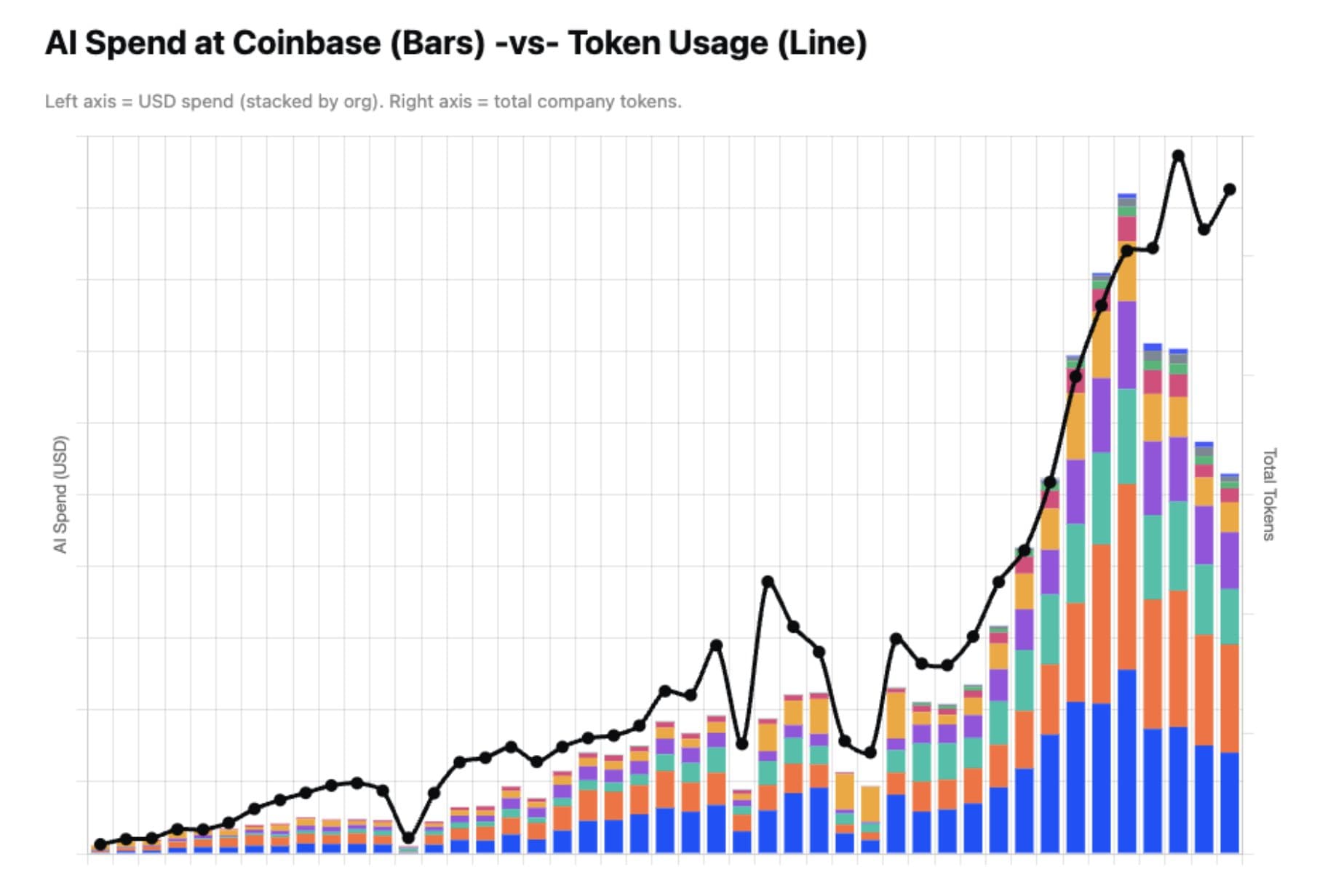
The most common lever is a model router — a system that sends each request to the model best suited to handle it, rather than defaulting every query to the most expensive option available. Coinbase has taken this approach directly, pairing cheaper default models with smart routing, aggressive caching and leaner context windows. Rather than imposing hard caps, the company relies on clear usage visibility to keep spend in check. Brian Armstrong, Coinbase's CEO, shared a view of the company's AI spend trajectory publicly — the chart below shows how token usage and dollar spend have tracked together as usage has accelerated.
Routing tools now come in several forms. OpenAI built automatic switching directly into ChatGPT with GPT-5, so the product itself decides when a simpler task can run on a lighter model. Vendors like OpenRouter offer more granular control, letting companies set a preference between cost and quality and routing traffic accordingly — the company reports that roughly a third of its traffic goes to Google's cheaper Gemini 2.5 Flash Lite model, against around 10 percent for OpenAI's more expensive GPT-5.5.
Some tools go further than model selection. Palantir's Evolve platform also rewrites the prompt sent to whichever model is chosen and prevents requests being resent unnecessarily, a common source of overcharges. Palantir says this combination cut computing costs for one customer task by 97 percent, simply by shifting a workload from OpenAI's GPT-5.1 to the smaller GPT-5.4 Nano. Construction firm McCarthy Building reported a 60 percent drop in token use this quarter using the same tool.
At the more improvised end, some teams skip commercial routers altogether and ask a cheap model to pick which other model should handle a given request. An engineer at Arcee AI uses DeepSeek's low-cost V4 Flash for exactly this — feeding it a list of available models and letting it make the call. It is a rough solution, but one that reportedly performs about as well as far more elaborate systems.
Build the visibility to catch spend before it becomes a problem
Routing addresses cost per query. The other half of the problem is knowing where the money is going in the first place, and several companies have built structures specifically for that.
Smartsheet has given a dedicated FinOps team ownership of the AI budget, with automated alerts before employees hit token limits and real-time dashboards broken out by department and manager. Meta is building similar infrastructure internally — an AI Gateway dashboard that tracks usage and spend in real time, sets budgets at the team and individual level, and flags unusual spikes automatically. Meta is also steering employees toward in-house tools like MetaCode rather than third-party models, which removes a chunk of external spend altogether.
Qualcomm has taken a more direct route with its heaviest-consuming teams, particularly engineering. The company caps their token usage outright and uses a show-back model so each department can see the actual dollar cost tied to its usage. It also runs smaller, older models on its own hardware for tasks that do not need frontier capability, cutting costs further without touching output quality where it matters.
Uber's experience is a useful cautionary note for any company still relying on informal limits. After early usage of third-party tools like Anthropic's APIs quickly burned through allocated spend, the company moved to hard annual budgets and closer monitoring of employee consumption to avoid further surprise overages.
The pattern worth taking from this
None of these companies are relying on a single fix. Coinbase pairs routing with caching and context discipline. Meta pairs visibility with a push toward internal tools. Qualcomm pairs caps with hardware economics. The common thread is that cost control now sits alongside model selection as a genuine operating discipline, not an afterthought handled once a year during budget season.
For most leaders, the useful question is not which single tactic to adopt, but which combination fits the shape of your own usage — and who inside the organisation is going to own watching it.