Microsoft surveyed 20,000 knowledge workers across 10 countries, analysed trillions of Microsoft 365 productivity signals, and arrived at a conclusion that should land hard in every boardroom: the bottleneck to AI value is not the technology. It's the organisation.
The 2026 Work Trend Index — "Agents, Human Agency, and the Opportunity for Every Organization" — is the most substantive workplace AI research published to date. It moves past the adoption conversation entirely. The question it asks is sharper: now that AI can execute, are your systems built to capture what that makes possible?
For leaders, the answer is mostly no. And the gap is widening.
The core argument
The opportunity for human potential at work has never been greater. As agents take on more of the execution, humans increasingly have more agency — more room to direct the work, make the calls, and own the outcomes.
Microsoft frames this as the "new agency equation." It is an elegant inversion of the fear-based AI narrative. The report does not argue that AI is taking work away from people. It argues that as AI absorbs execution, humans are freed to do something more valuable: set direction, exercise judgment, and own outcomes. The ceiling on individual contribution rises. The question is whether organisations are structured to let people reach it.
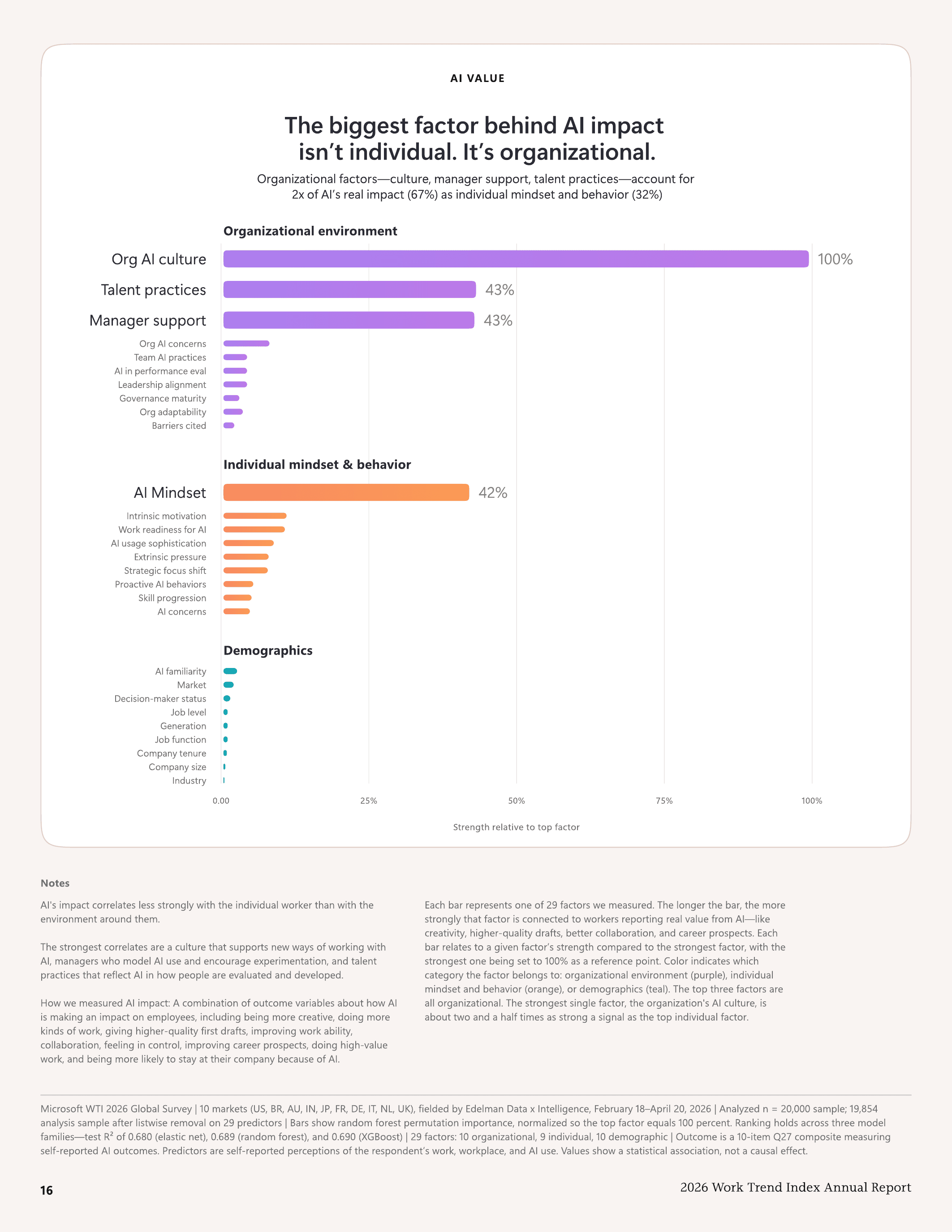
The constraint for most firms is the gap between what their employees can now do and what their organisations are built to support. Organisational factors — culture, manager support, talent practices — account for twice the reported AI impact of individual effort alone.
That 2x figure is the most important number in the report. It means that investing in individual AI skills without fixing the organisational environment around those skills produces roughly half the return. The lever that matters most is not the tool — it is the system the tool operates within.
What the data shows
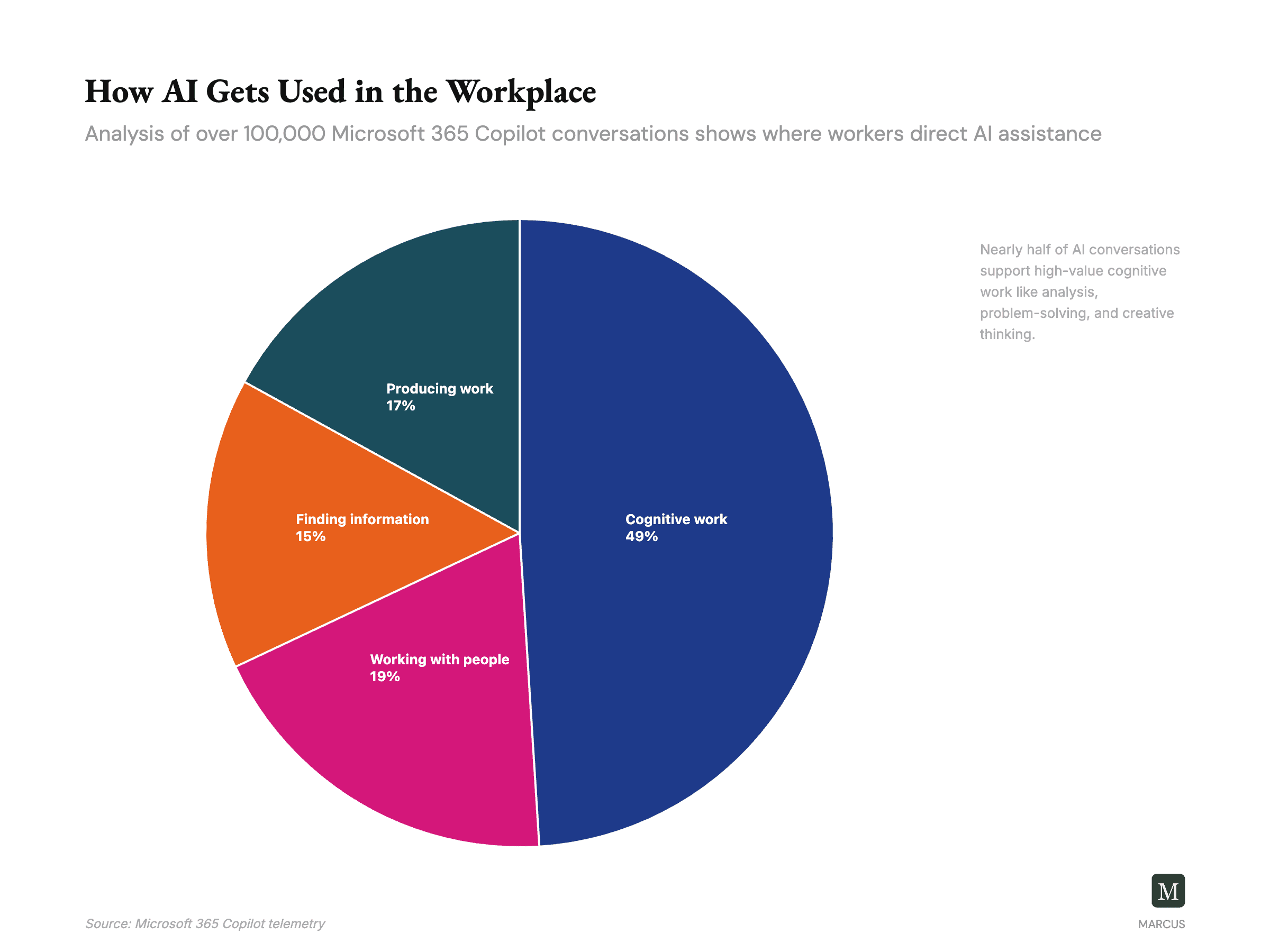
A privacy-preserving analysis of more than 100,000 chats in Microsoft 365 Copilot shows that 49% of all conversations support cognitive work — helping workers analyse information, solve problems, evaluate, and think creatively. The remainder splits among working with people (19%), finding information (15%), and producing work (17%).
This is a significant finding. Nearly half of all AI usage is already concentrated in the highest-value cognitive categories — analysis, reasoning, decision support. AI is not primarily being used to format slides or write emails. It is being used to think. That has direct implications for what leaders should expect from their teams and how they should evaluate AI's contribution.
66% of AI users say AI has allowed them to spend more time on high-value work, and 58% say they're producing work they couldn't have a year ago.
Both numbers jump sharply among what the report calls Frontier Professionals — the most advanced AI users, who use agents for multi-step workflows, routinely rethink workflows, and participate in practices like creating shared AI standards for their team or organisation. They represent a small but disproportionately valuable group: 16% of the AI users surveyed.
What sets Frontier Professionals apart isn't which mode they use; it's knowing which mode a task calls for. Routine execution, research, and synthesis get delegated. As AI does more of the work, humans stay involved by setting direction and taking responsibility for how outputs are used.
That distinction — between using AI and directing AI — is where senior leaders need to locate themselves.
!The four modes of working with AI: Delegation, Collaboration, Asking, and Exploration
The Transformation Paradox
The most operationally significant finding in the report is what Microsoft calls the Transformation Paradox, and it deserves careful attention.
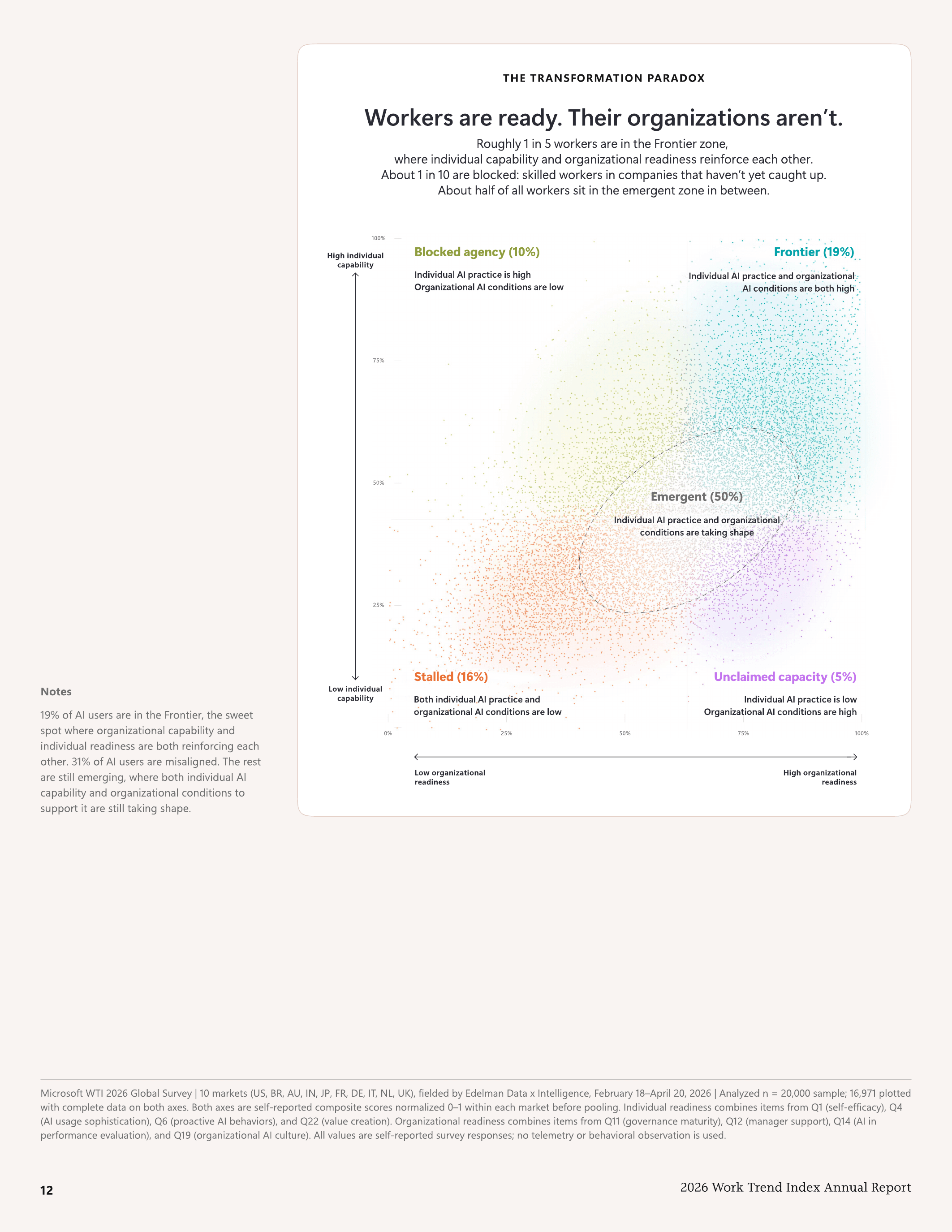
Only 19% of AI users are in the Frontier zone, where organisational capability and individual readiness are both high and reinforcing each other. At the other end, 16% are stalled, with low capability and limited organisational support. The rest are misaligned: 10% fall into blocked agency, where individuals have built strong skills but lack the systems to apply them.
Read that again. One in ten AI users is actively blocked — skilled people being held back by organisational conditions that have not caught up. Another 50% sit in the emergent middle, where both individual practice and organisational conditions are still forming. Only one in five workers is in a position where their capabilities and their environment are genuinely aligned.
65% of AI users fear falling behind if they don't use AI to adapt quickly, yet 45% say it feels safer to focus on current goals than to redesign work with AI. And only 13% of AI users say they're rewarded for reinvention of work with AI even if results aren't met.
This is the paradox in precise terms. The organisation's measurement and incentive systems are pulling in the opposite direction from its stated AI ambitions. People feel the pressure to change, but the system punishes the experimentation that change requires. Leaders who have announced AI strategies without updating their operating models have created exactly this tension.
Only one in four AI users surveyed (26%) say their leadership is clearly and consistently aligned on AI.
That is a governance problem, not a technology problem.
The manager variable
One of the most concrete findings in the report concerns the role of direct managers in AI adoption outcomes. A separate study of 1,800 workers globally found that when managers actively modelled AI use, employees reported a 17-point lift in reported AI value, a 22-point lift in critical thinking about their AI use, and a 30-point lift in trust in agentic AI. When managers created psychological safety around experimentation, employees reported up to 20 points higher AI readiness and value — and were 1.4x more likely to be high-frequency users of agentic AI.
These are not marginal effects. A manager who openly uses AI, sets quality standards for AI work, and creates space for experimentation produces dramatically different outcomes than one who does not. The behaviour of middle management is a stronger predictor of AI impact than the tools an organisation deploys.
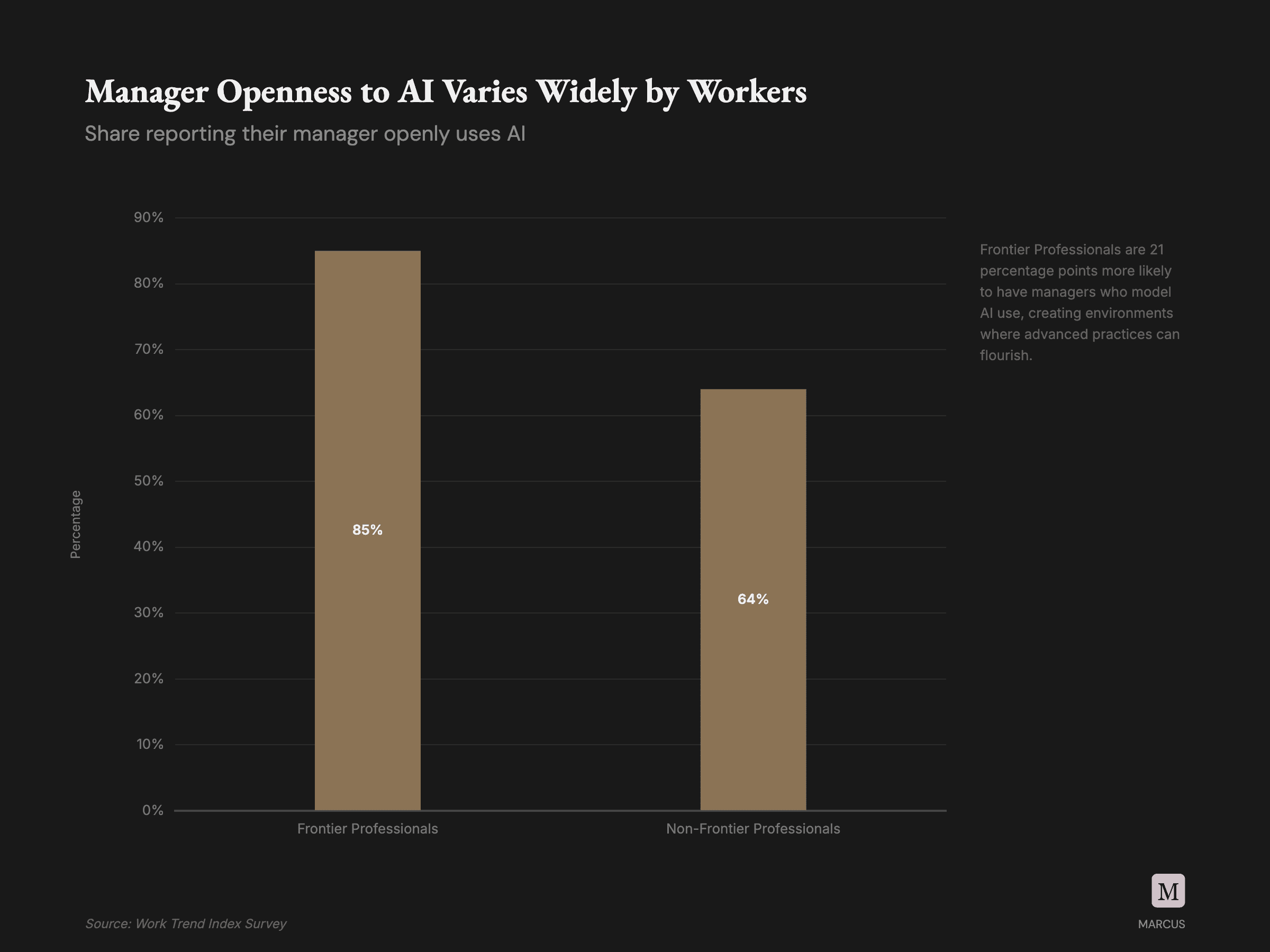
Frontier Professionals are significantly more likely to say their manager openly uses AI (85% vs. 64%), sets quality standards for AI work (83% vs. 57%), creates space for experimentation (84% vs. 61%), and encourages more ambitious work redesign (87% vs. 61%).
For senior leaders, this points to a specific, actionable priority: AI transformation is a management capability problem as much as a technology or strategy problem. What you model and what you measure will determine what your managers do, and what your managers do will determine what your teams achieve.
Every firm is a Learning System
The third section of the report introduces a concept that has real strategic weight.
The firms pulling ahead are focused on AI absorption rather than just AI adoption, redesigning how work gets done and turning output into insight. When that insight gets captured, shared, and built into how the organisation operates, it creates a self-reinforcing Learning System.
The distinction between adoption and absorption is important. Adoption is deploying tools. Absorption is changing how work is actually designed, capturing what those changed processes teach you, and feeding that learning back into the system. Most organisations have achieved the former. Very few have built the latter.
The number of active agents in the Microsoft 365 ecosystem has grown 15x year over year, rising to 18x in large enterprises. As agents scale, they generate signals — what worked, what failed, where quality drifted. Frontier Firms capture these signals and encode them into shared routines, improving future work while preserving accountability and control.
Every Frontier Firm needs to build Owned Intelligence — institutional know-how that compounds over time, is unique to the firm, and hard to replicate.
This is the competitive moat. Not access to the best AI model — any organisation can license that. The moat is the institutional learning loop: the feedback system that continuously improves how the organisation uses AI, embedded in its processes and people rather than sitting in individual workers who might leave.
The judgment premium
One theme runs through all three sections of the report and deserves to be stated plainly.
Asked which human skills are more important as AI takes on more work, knowledge workers said two topped the list: quality control of AI output (50%) and critical thinking — analysing information objectively and making a reasoned judgment (46%). 86% say they treat AI output as a starting point, not a final answer, and that they "stay responsible for the thinking."
The premium on judgment is rising precisely because execution is becoming abundant. When AI can produce a first draft, an analysis, a recommendation, or a plan in seconds, the scarce and valuable input is the human capacity to evaluate whether it is right, catch what it missed, and take responsibility for the decision.
The question stops being "What tasks define my job?" and starts being "What outcomes am I now positioned to drive?"
For senior leaders, that reframing applies at every level of the organisation. The leaders who will create the most value from AI are those who can identify where judgment is genuinely required, protect the conditions for it to be exercised well, and build teams where the human role is clearly centred on direction, evaluation, and accountability rather than execution.
What this means for your organisation
The report's findings point to four leadership priorities, none of which involve buying more software.
Audit your incentive structure. If only 13% of employees feel rewarded for reinvention, your measurement systems are working against your AI strategy. The metrics that govern performance reviews, resource allocation, and recognition need to reflect the behaviours you are trying to build.
Make AI visible at the top. The data on manager modelling is unambiguous. If senior leaders are not visibly using AI, setting quality standards for it, and talking concretely about how they are redesigning their own workflows, they cannot expect the rest of the organisation to take the mandate seriously.
Treat knowledge capture as an operating requirement. Every AI-enabled workflow in your organisation is producing signals. Most of those signals are being lost. Build the infrastructure to capture what works, document it, and distribute it. The organisations that do this faster will compound their advantage over those that don't.
Focus on judgment, not just capability. The most dangerous organisational response to AI is one that optimises for speed of output without investing in the capacity to evaluate that output. Quality control of AI work is now a core competency at every level. Build it deliberately.