Every leadership team has run the AI speed test by now. Drafts that took a day now take an hour. Code ships faster. Decks assemble themselves. By almost every individual measure, AI has delivered exactly what the roadmap promised.
So why does the organisation feel more chaotic, not less?
A new report from Atlassian's Teamwork Lab — based on interviews with 172 Fortune 1000 executives and a survey of over 12,000 knowledge workers — has a straightforward answer. AI is making individuals faster and teams messier, and the gap between those two facts now has a price tag: $161 billion a year across the Fortune 500 alone.
The report calls it the fragmentation tax. It is worth understanding properly, because most AI strategies are built in a way that makes it worse.
Speed without coordination doesn't add up
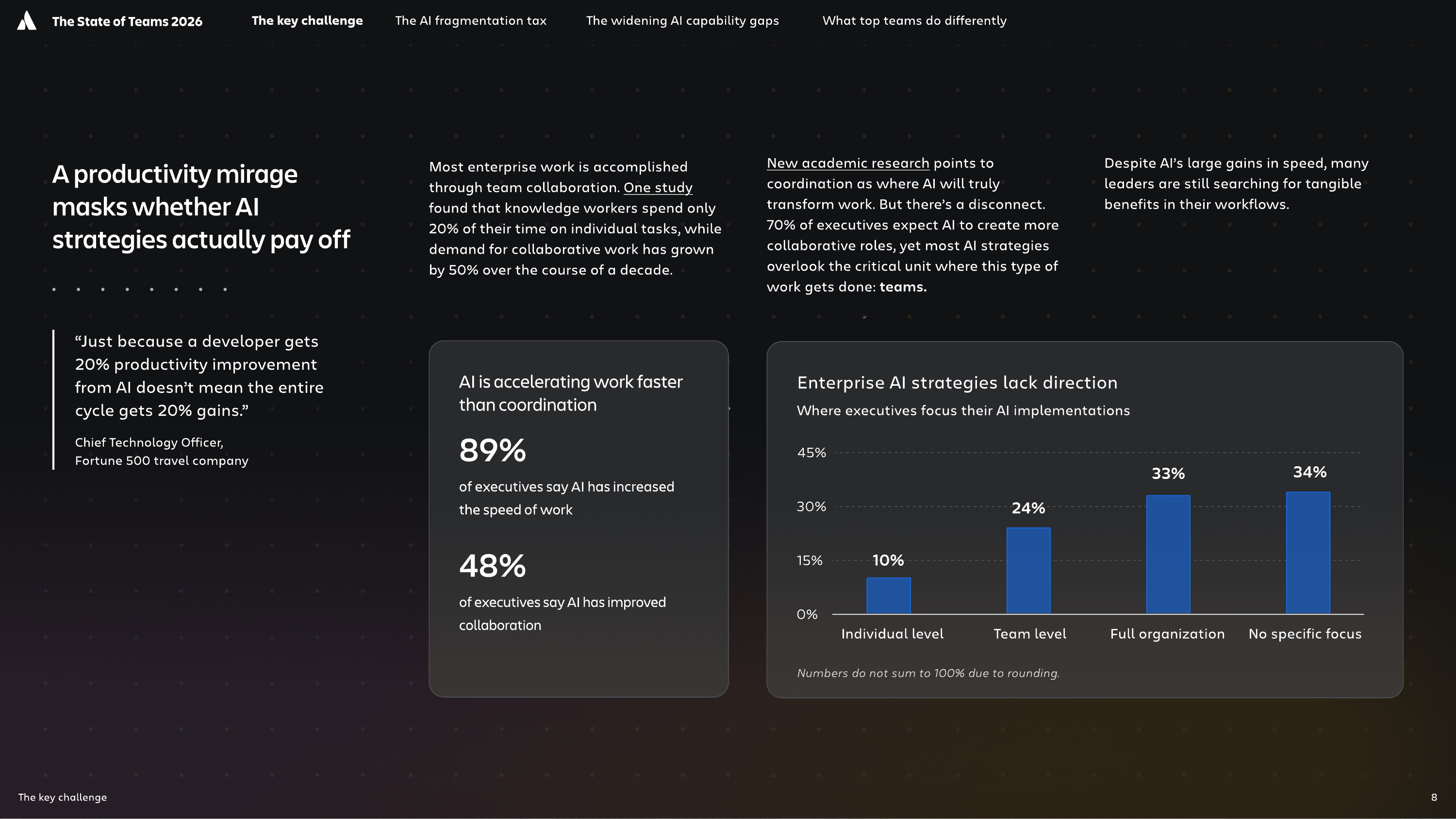
Start with the number at the centre of the report. 89% of executives say AI has accelerated the speed of work. Just 6% are confident they can point to specific ROI across their organisation.
That gap between perceived speed and provable value is the tell. The acceleration is real, but it is isolated — concentrated in individual output rather than collective results. A product manager's agent produces a forty-page brief before the coffee's cold. A designer generates a week's worth of concepts before lunch. Each of those is a genuine win on its own terms. None of them means much until someone else on the team can absorb, check and act on the output.
One Fortune 500 marketing leader in the report put it well: a product has multiple components, but they don't mean anything on their own — the team has to connect them together. AI has made each component faster to produce. It has done nothing to make the connecting easier. In plenty of cases, it has made it harder, because the volume of output arriving at each handoff has grown faster than the team's ability to process it.
The report calls this the power-user paradox. A single high-output contributor looks like a win on a dashboard and lands as a bottleneck everywhere downstream. Engineering gets flooded with uncoordinated requests. Reviews back up. The bottleneck was never execution. It is coordination — and coordination is the layer most AI strategies leave out entirely.
Why most AI strategies miss it
The report's diagnosis is specific. Only 24% of AI implementations focus on teams. Individual productivity remains the dominant metric almost everywhere else. That would make sense if individual output were where most of the value sat. It is not. Knowledge workers spend 80% of their time on collaborative work. The metric and the majority of the actual work are pointing in different directions.
This shows up in how AI success gets measured at the top. 73% of executives measure AI success through productivity and efficiency gains, both individual-level metrics. 58% admit they do not know how to measure AI's ROI at all. As one Fortune 500 healthcare executive told the researchers, calculating ROI at the individual level is simple and black and white. At the team level, it is a different question, and most organisations have not built the muscle to answer it.
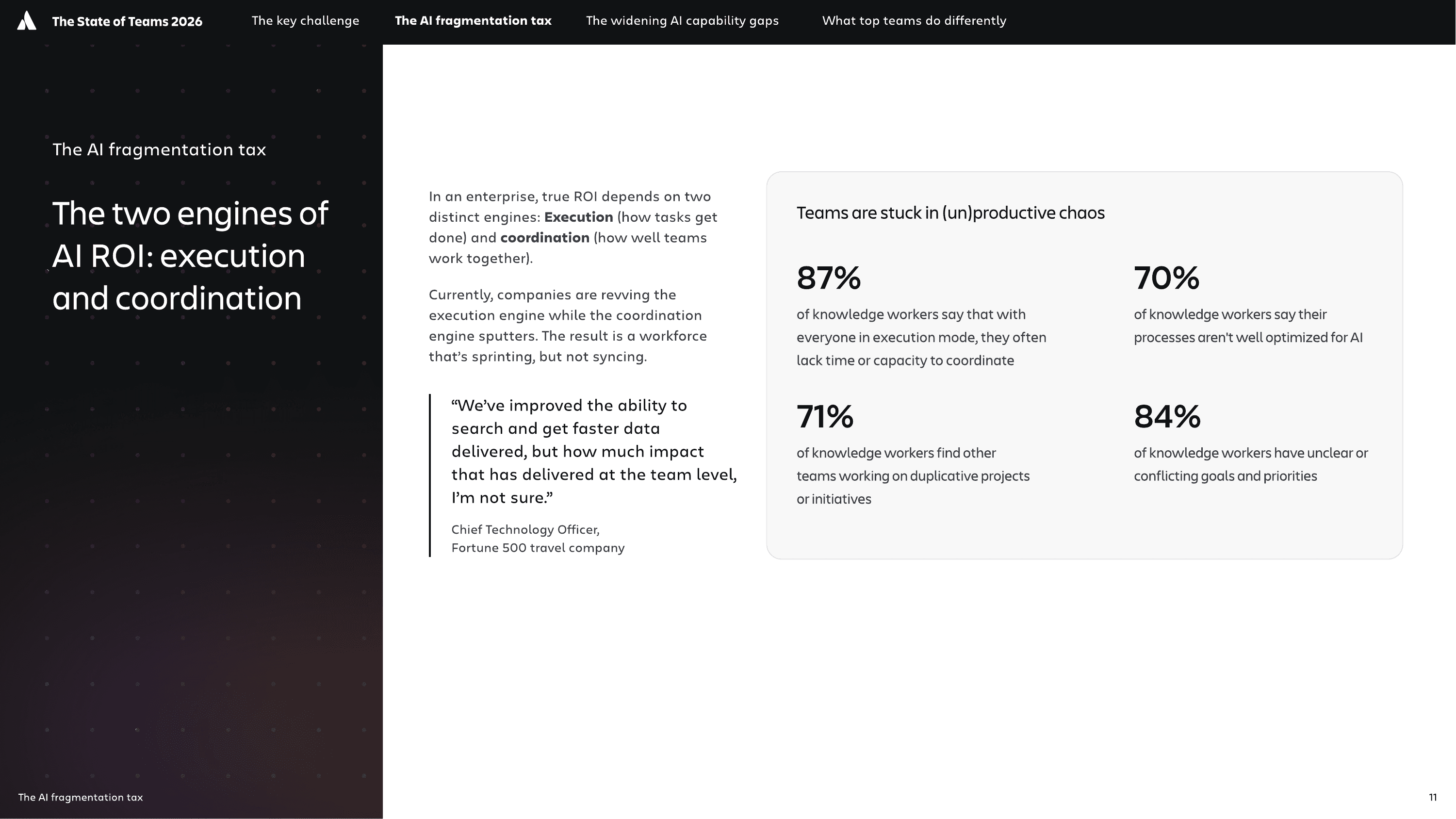
The result is a coordination engine that is stalling while the execution engine redlines. 87% of knowledge workers say that with everyone in execution mode, they lack the time or capacity to coordinate. 71% find other teams working on duplicative projects. 84% report unclear or conflicting goals and priorities. This is not a training gap. It is what happens when speed increases and alignment does not.
Workslop: the quality cost nobody budgeted for
There is a second effect worth a board's attention: quality degradation under AI-driven speed. The report has a name for it — workslop — low-quality, unverified AI output that looks finished but takes more work to fix than it would have taken to do properly in the first place.
49% of knowledge workers say their AI outputs are not reliably high-quality. 48% say using AI now requires a trade-off between speed and quality that did not previously exist. The top complaint is not that AI is slow. Nobody is clear on who is responsible for catching and fixing the errors it introduces. A Fortune 500 retail executive summed up the experience well — you think you are moving faster, until you discover a quality gap, and what looked like a 20% gain gets pulled straight back.
This matters for a leadership team because workslop is invisible in most reporting. Individual velocity metrics will show the win. The rework, the extra review cycles, the erosion of trust in AI-produced material — all of that shows up elsewhere, usually as a vague sense that things feel slower than the metrics suggest.
The capability gap is widening, not closing
If fragmentation were spread evenly across the organisation, it would be simpler to fix. It is not. 55% of executives say AI has widened performance and opportunity gaps between teams. Only 12% report widespread AI use across their organisation. A minority of power users are pulling away from everyone else, and the gap grows because leadership investment is tilted toward tools rather than people. Executives are almost twice as likely to invest in new AI tools and technologies as they are to invest in upskilling their people for the AI era — 84% versus 31% offering extensive AI learning and development.
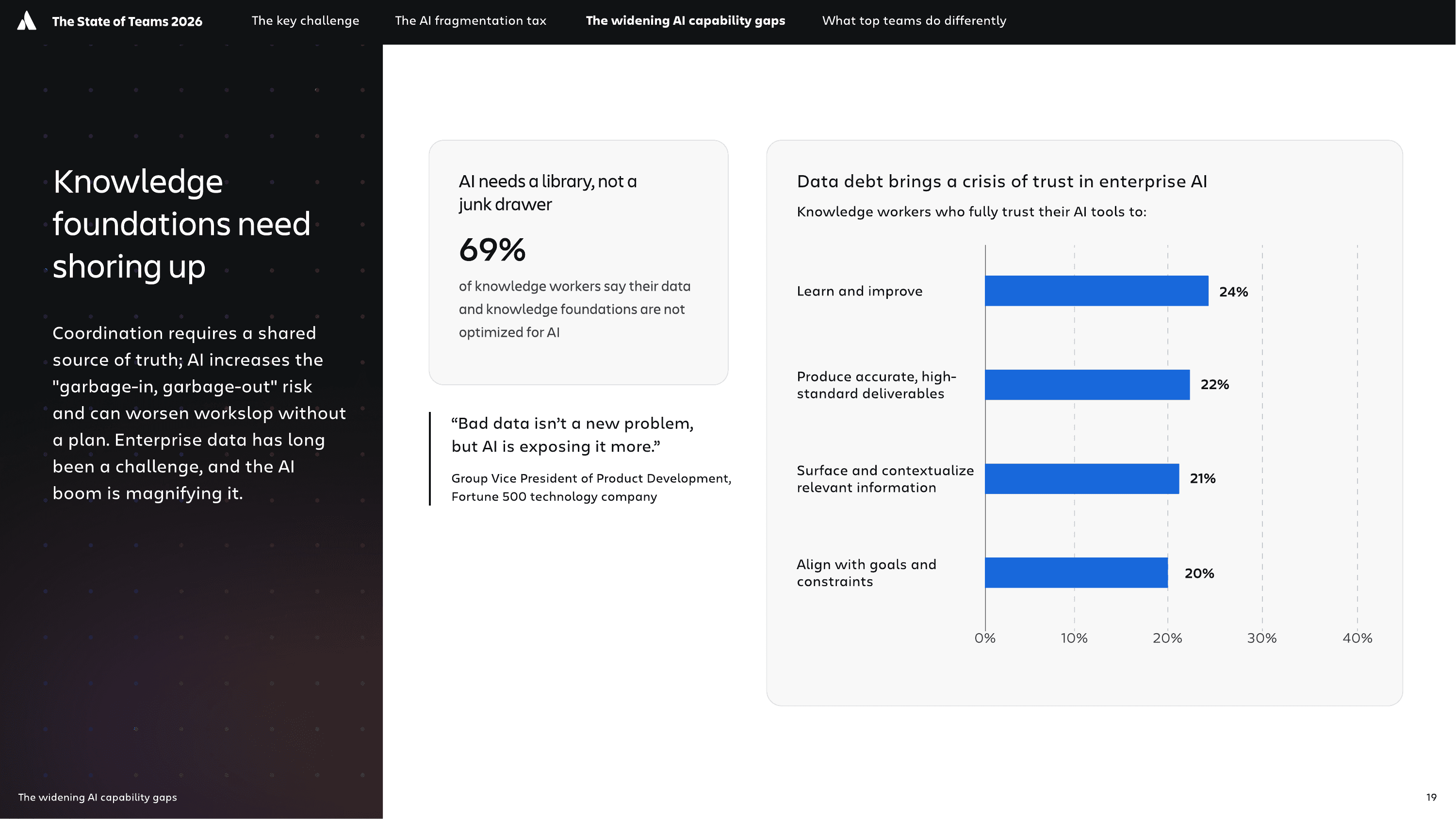
Underneath this sits a trust problem that is easy to underestimate. Only 22% of knowledge workers fully trust AI to produce accurate, high-standard deliverables. 69% say their data and knowledge foundations are not set up for AI in the first place. As one Fortune 500 technology executive put it to the researchers, bad data is not a new problem — AI is just exposing it more visibly, and faster, than anything that came before it.
These are not separate issues. They form one loop that reinforces itself. Unreliable data produces unreliable AI output. Unreliable output erodes trust. Low trust means the organisation never builds the shared workflows that would have fixed the data problem in the first place.
What the top teams are doing instead
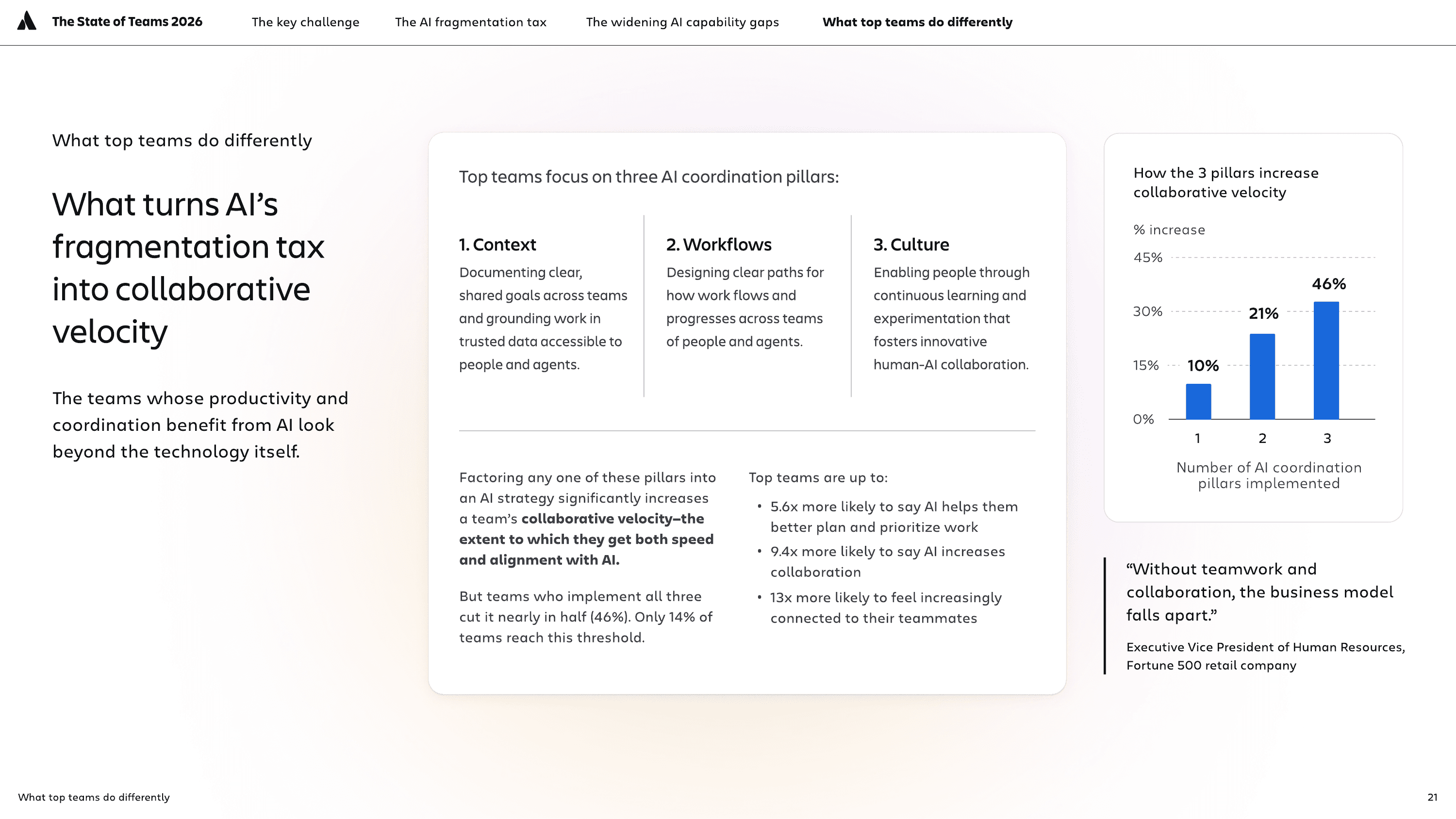
The report's most useful finding is the pattern among the small group of teams who have actually solved this. Just 14% of teams have implemented all three of what the researchers call the AI coordination pillars: context, workflows and culture. That 14% does not just perform marginally better. They cut the fragmentation tax nearly in half — a 46% gain in collaborative velocity, against 30% for teams implementing two pillars and roughly 15% for one.
Context means grounding people and agents in a shared, trusted source of truth — clear priorities, defined quality standards, and a knowledge base built for AI to draw on rather than a pile of half-updated documents. Teams that get this right are 12 times less likely to experience unclear or conflicting priorities, and 7.3 times more likely to say their data foundations are genuinely fit for AI.
Workflows means redesigning how work actually moves between people and agents, rather than handing individuals faster tools and hoping the handoffs sort themselves out. This is the pillar with the sharpest numbers. Teams that do it well are 13 times more likely to say their people are aligned on how and where to use AI, and nearly eight times less likely to report having no time to coordinate.
Culture is the multiplier that makes the other two stick. It is the difference between AI being tolerated and AI being genuinely taken up — teams with strong AI cultures are more than three times as likely to say people are encouraged to experiment and find what works for them, rather than being handed a tool and left to work it out alone.
None of these three pillars is mainly a technology decision. They are leadership decisions, about what gets measured, how work is structured, and what kind of behaviour gets rewarded when someone tries something with AI and it does not quite work.
The takeaway for the C-suite
The uncomfortable part of this report is that AI has not created new problems. It has made old, tolerated inefficiencies impossible to ignore. Misaligned priorities, duplicated effort, unclear ownership — these existed long before generative AI. They were simply slow enough that teams could absorb them quietly. AI has removed that slack. Every gap in coordination now shows up faster, and at higher volume, than it used to.
Organisations treating this as a tooling problem — buy more licences, roll out more copilots — are pulling the wrong lever. The report's own language for it is exact: they are revving execution while coordination sputters. The fix is not slower AI adoption. It is making the coordination layer a deliberate, resourced part of the strategy, with the same seriousness currently reserved for the technology itself.
Atlassian's Vice President of Information Security described the current state of many organisations as an orchestra without a conductor. Every section is playing well individually. Nobody has decided what the piece actually sounds like together. That is the job only leadership can do, and no amount of individual AI capability will do it in their place.