For thirty years, the largest enterprises had leverage over their software vendors. They could demand custom features, negotiate bespoke implementations, and get dedicated engineering resources. SAP, Salesforce, Workday — they all bent to the biggest contracts.
But that leverage came at a price: long implementation cycles, expensive consulting layers, and solutions that were custom in name but still built around the vendor's core architecture. And for everyone below the Fortune 500, the option barely existed. You bought what was on the shelf and adapted your workflows to fit.
That two-tier system is now collapsing from the bottom up. When any organisation — not just the ones with nine-figure IT budgets — can move from idea to functional application in days, the leverage dynamic inverts. You no longer need a vendor's engineering team. You don't need to negotiate. You build.
That's the shift most executives haven't fully priced in.
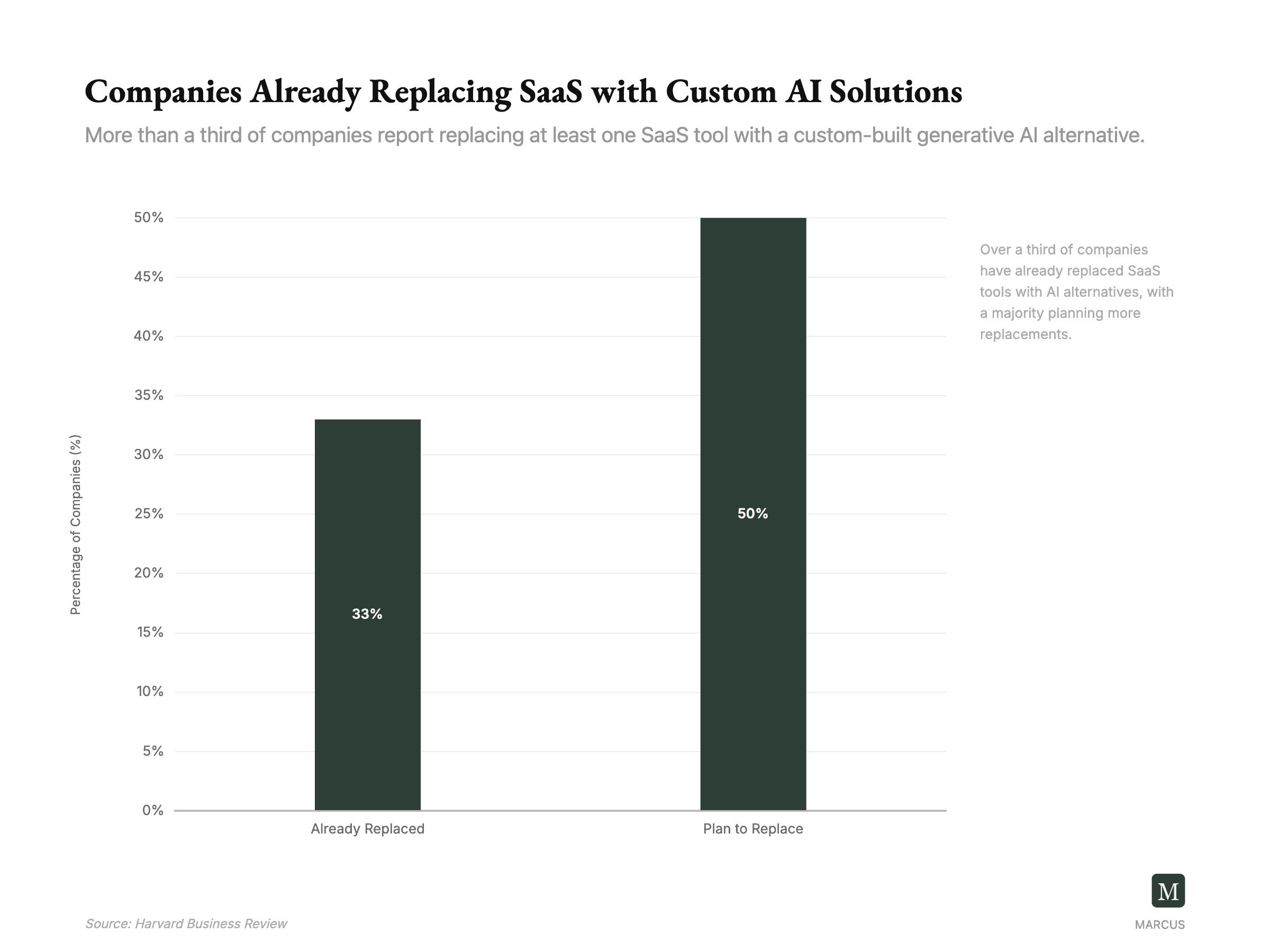
A new HBR piece by Deep Nishar and Nitin Nohria puts numbers to what many leaders are already sensing. Enterprise spending on generative AI applications surged from $1.7 billion in 2023 to $37 billion in 2025. More than a third of companies have already replaced at least one SaaS tool with a custom-built AI alternative. Public SaaS valuations have compressed 30–60% from their 2021 peaks. The direction of travel is clear.
The Question That Actually Matters
The old build-or-buy decision was largely settled by economics. Custom software was expensive, slow to build, and hard to maintain. So you bought what was available and worked around its limitations. That constraint is gone. What once required months of engineering and seven-figure budgets can now be produced in days.
Which means the question is no longer can we build this? It's should we?
And underneath that is the question your leadership team needs to sit with: Which capabilities are genuinely distinctive to how your organisation creates value, and which are just operational overhead dressed up as strategy?
Most companies have never had to answer this clearly. They didn't need to. The software made the decision for them by default. Now the decision is yours, and it will define your competitive position for the next decade.
Four Models, One Strategic Choice
Nishar and Nohria describe four emerging models that are replacing the traditional buy-and-configure approach. Understanding them is less about picking a model and more about forcing honest clarity on where your organisation actually creates value.
Build — You construct proprietary systems directly on top of foundational AI models. The logic here is differentiation: if a capability is genuinely core to how you win, you want to own it, shape it, and deepen it over time. A logistics company that builds its own delivery optimisation system isn't just saving on software costs — it's building institutional knowledge into a system that compounds in value. The honest check: does this capability encode truly distinctive data or decision logic that competitors can't easily replicate? If not, you're overreaching.
Compose — You use flexible, AI-native platforms that allow deep configuration without building from scratch. The difference from traditional SaaS is directional: instead of your organisation adapting to the software, the software adapts to you. This works well for functions where you want differentiation without full technical ownership. Watch for the ceiling — when customisation starts feeling forced, that's a signal you either need to build more directly or rethink the function entirely.
Collaborate — You work with external partners who deploy forward-facing teams to build bespoke systems around your specific workflows. What previously required 18-month ERP implementations can now be done in weeks. The risk is dependency: if you repeatedly outsource the building of strategically important systems, you may be masking a capability gap you should be internalising.
Buy outcomes — You stop purchasing software altogether and contract for results. Rather than licensing accounting software and running it internally, you pay a provider for accurate financials and compliance as a service. Adobe has already moved in this direction, pricing by successful ad campaigns completed by AI agents rather than by seat or token. This model works best for non-differentiating functions. If a domain starts shaping competitive advantage, you'll want to reclaim control.
Most organisations will use all four simultaneously, across different functions. The point isn't to pick one. The point is to make deliberate choices about which model applies where — and to stop letting inertia or vendor relationships make that choice for you.
What This Means for the C-Suite
This is not an IT decision. It's a business model decision.
When an AI system performs work that was previously done by a team of people, decisions about technology are simultaneously decisions about organisational design. When a function can be built internally for a fraction of its previous cost, the question of whether to outsource it becomes a question about your competitive identity. When workflows that used to require standardised vendor software can be rebuilt to reflect how you actually operate, you have to decide what "how you actually operate" really means.
Here's what that looks like in practice for each function in the room:
For CEOs: The boundary of the firm is no longer fixed. Which capabilities should be drawn deeper inside your organisation and rebuilt as proprietary assets? Which should move to external partners who can perform them at higher quality or lower cost? This is a strategic portfolio decision, not an operational one, and it should be on your agenda for every major function you oversee.
For CFOs: The ROI math on traditional SaaS is shifting. Subscriptions that made sense when custom alternatives were prohibitively expensive now need to be revalidated. At the same time, rushed AI investment without disciplined data architecture will produce high spend and poor returns. The discipline is in building strong data foundations before automating on top of them — fragmented, vendor-managed data limits what AI systems can actually do.
For CHROs: Workforce implications are immediate and significant. When a generative AI system absorbs workflows that teams of people previously handled, the org design question arrives before most HR functions are ready for it. The question isn't just headcount — it's which human capabilities become more valuable as AI handles volume, and how you retain and develop those capabilities.
For CTOs: Governance is moving to the centre, not the periphery. As more software gets built outside traditional IT structures — by business users, external collaborators, AI-generated code — questions of security, maintainability, and accountability become acute. Forty percent of code is now AI-generated. That's not a trend you're managing at the edges; it's inside your core systems already.
The Trap to Avoid
Moving fast is not the same as moving well.
The organisations that have stumbled earliest in this transition share a common pattern: they automated quickly without rebuilding their data and operational foundations first. The result is AI systems layered on top of fragmented data, producing inconsistent outputs, accumulating edge cases, and becoming progressively harder to manage.
The lesson isn't to slow down. It's to treat data architecture, governance, and ownership as integral to the transformation — not as prerequisites you'll sort out later. Organisations that get this right will compound advantage. Those that rush past it will spend the next three years unpicking the mess.
The Real Stakes
Here's the shift that matters most, and that the HBR article gestures toward without fully naming: for a generation, competitive advantage in enterprise operations was largely about execution quality within standardised systems. Everyone ran the same ERP. Differentiation came from how well you used it.
That's over.
When systems can be built to encode your specific data, your specific decision logic, your specific way of creating value, the differentiation becomes structural rather than operational. The companies that identify their genuinely distinctive capabilities and build depth in those areas will be materially harder to replicate than those that continue treating technology as a commodity input.
The companies that don't make these choices deliberately will have them made by default — by their vendors, by their inertia, and eventually by their competitors.
Three Questions for Your Next Leadership Meeting
Before your organisation spends another dollar on enterprise software — or another quarter deferring AI investment — three questions deserve answers at the table:
Which workflows are we currently running on standardised software that actually represent sources of differentiation for us? If a competitor ran the same process the same way, would it matter?
Where are we adapting our organisation to fit the software, rather than the software fitting how we work? And is that adaptation costing us more than we've accounted for?
If we could rebuild this function from scratch around how we actually want to operate, what would that look like? What's stopping us?
The build-or-buy question has been reframed. The economics have changed, the technology has changed, and the strategic stakes are higher than they've been in thirty years. What hasn't changed is the cost of letting the question answer itself.